


Table of Contents
In the fascinating world of artificial intelligence, the temperature of a language model is an often overlooked but crucial parameter. This setting can transform a model’s behavior, influencing the predictability and creativity of the generated responses. Let’s dive into the subtleties of this key concept.
Imagine yourself on a gentle summer afternoon, exploring the vast possibilities offered by artificial intelligence models on Hugging Face. You are faced with a myriad of options, each model promising to respond to your prompts in a unique way. After selecting a model, one last choice remains: setting the temperature. This often mysterious parameter can radically change the outcome of your request. How does it work exactly?
Key takeaways
Language models, such as those found on platforms like Hugging Face, do not intuitively guess words. They calculate a probability for each possible word at each stage of generation. Temperature is an adjustment of this probability, allowing for influence over word selection.
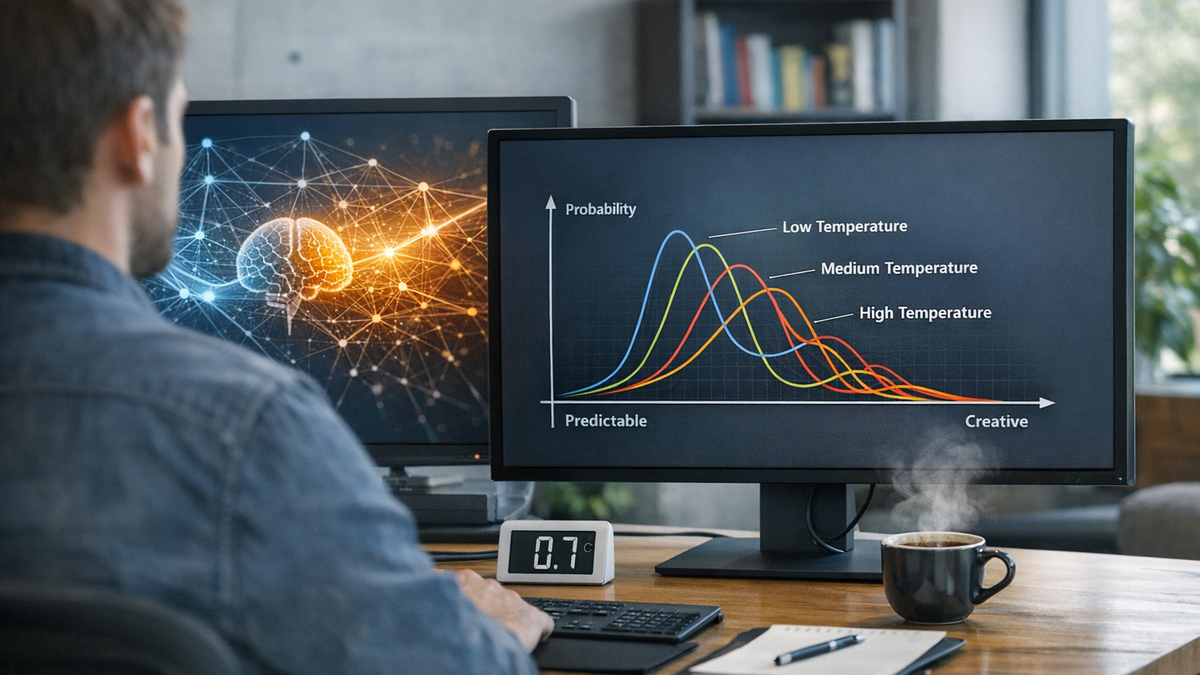
When the temperature is low, it tightens the probabilities around the most expected words. This setting often leads to responses that are repetitive and very similar to each other. Conversely, a high temperature flattens the probability distribution, allowing less obvious words to be chosen. However, this does not mean that the texts will be more inventive or coherent.
IBM illustrated this effect using its Granite model. At low temperature, the responses were sober and predictable. A medium temperature added details, while high temperatures led to unexpected responses. However, it is important to note that temperature does not directly affect the creativity or originality of the generated text.
According to a study conducted by Peeperkorn and colleagues, temperature has a low correlation with the novelty of a text and a medium correlation with its inconsistency. This research highlights that increasing temperature can make a model less faithful to its training, without necessarily guaranteeing more creative results.
Beyond practical demonstrations, understanding temperature in language models is essential for developers seeking to achieve a balance between coherence and creativity. They must adjust the temperature according to the context of use, whether for applications requiring precise responses or more diverse content generators.
The future of artificial intelligence is inseparable from continuous improvements in text generation. Companies like OpenAI and Google are investing heavily in research to refine language models. These advances aim to offer AI capable of understanding and generating text with unprecedented precision and originality, while respecting cultural and contextual nuances.
What is temperature in a language model?
Temperature is a parameter that influences the probability of word selection during text generation by a language model.
How does temperature affect text output?
A low temperature produces predictable and factual texts, while a high temperature allows less probable words to be chosen, which can lead to more varied responses.
Does temperature influence a model’s creativity?
No, a higher temperature does not guarantee increased creativity. It simply increases the diversity of chosen words, without necessarily improving the creativity or cohesion of the text.
Can temperature be adjusted on all models?
This setting is generally accessible via APIs or on certain platforms like Hugging Face, but in most consumer chatbots, it is automatically managed by the system.