


Table of Contents
Infomaniak, a Swiss technology company, celebrates an important milestone for its cloud storage service, kDrive, which has just surpassed the one million user mark. This service stands out for its respect for privacy and compliance with data protection regulations.
Are you looking for a reliable alternative to the American cloud giants? Discover how kDrive, with its principles of privacy and security, has attracted a million users. What makes this service so attractive to those who prioritize personal data protection?
Key takeaways
Infomaniak prides itself on protecting its users’ data. Unlike many American cloud services, kDrive does not resell personal data or conduct targeted advertising. Files are secured with an encrypted connection via the TLS protocol and stored on servers located in Switzerland.
This approach ensures that users’ data is not subject to the American Cloud Act, providing an additional layer of protection. With AES 128-bit encryption at rest, kDrive ensures a high level of security, although end-to-end encryption is not yet available, unlike Proton Drive.
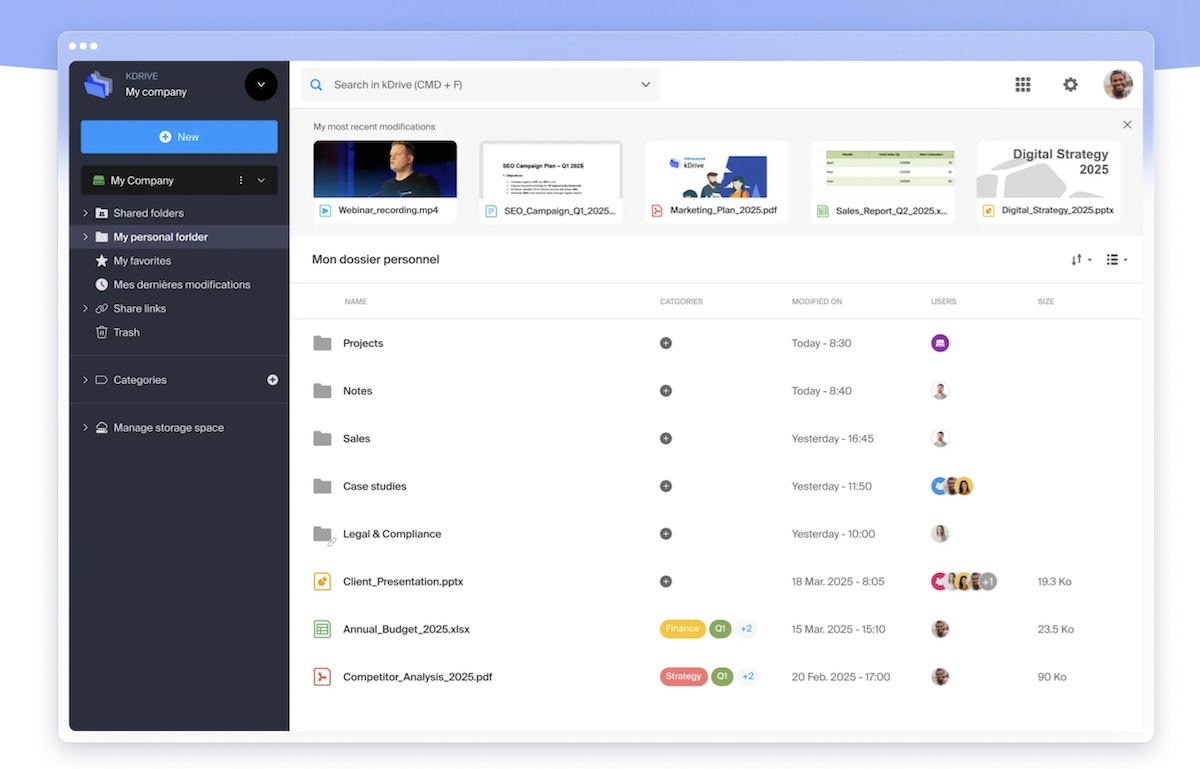
kDrive stands out with an attractive economic offer, with prices half those of competitors like Google Drive or Dropbox. The service includes advanced collaborative tools, such as real-time editing via OnlyOffice and drop boxes, which enhance team productivity.
Although it still lacks certain features like differential synchronization and optimized photo management on mobile, kDrive continues to develop. Its strategy is based on paid subscriptions, with a free my kSuite offer including 15 GB of storage and 20 GB of messaging.
As a European alternative, kDrive faces powerful rivals like Google Drive and Proton Drive. While kDrive offers robust collaborative tools, it lags behind in zero-knowledge encryption, a feature that Proton Drive offers from its free plan.
Infomaniak emphasizes that, despite this competition, the subscription-based economic model attracts many users seeking a privacy-respecting solution. However, the share of active users among the million accounts remains unknown, as does kDrive’s actual market share.
Infomaniak continues to innovate in the cloud domain, seeking to fill kDrive’s gaps and expand its range of features. The company might consider integrating zero-knowledge encryption to further enhance user data security.
By investing in research and development, Infomaniak aims not only to maintain its competitiveness against global players but also to meet the growing expectations of users for transparency and data protection.
In a context where data protection is becoming a global priority, European cloud services like kDrive are increasingly sought after. With players like Nextcloud and Tresorit, Europe is establishing itself as a bastion of data privacy and security.
These services, relying on sovereign infrastructure and strict GDPR compliance, offer an attractive alternative to American solutions, thus meeting a growing demand for ethical and transparent cloud solutions.
What are the main advantages of kDrive compared to Google Drive?
kDrive offers enhanced security with hosting in Switzerland and strict compliance with European regulations. Additionally, it offers competitive pricing and advanced collaborative tools, without data resale or targeted advertising.
Does kDrive offer end-to-end encryption?
Currently, kDrive uses AES 128-bit encryption at rest but does not offer end-to-end (zero-knowledge) encryption. This remains an area where improvements could be considered by Infomaniak.
How does kDrive position itself against Proton Drive?
kDrive stands out with its more extensive collaborative tools, but Proton Drive offers zero-knowledge encryption from its free plan, which may appeal to users concerned about data confidentiality.
Does Infomaniak plan any developments for kDrive?
Infomaniak seems to be on a continuous innovation trajectory, with the possibility of improving security and potentially adding new features to meet user expectations.